Réservez vos activités et excursions : Temple du Soleil de Konùrak
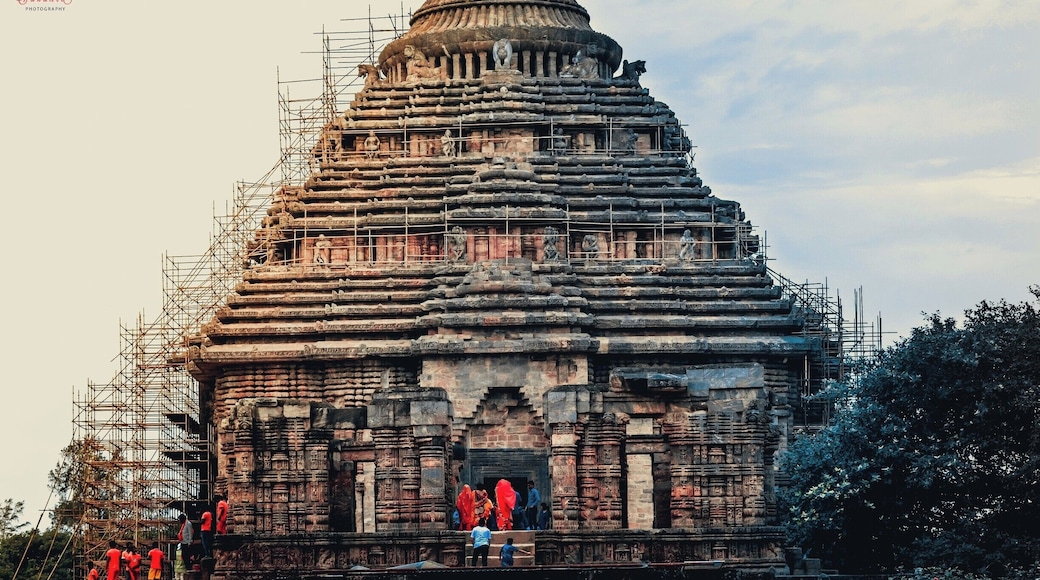
![Konark Sun Temple is a 13th-century CE Sun Temple at Konark in Orissa, India. It is believed that the temple was built by king Narasimhadeva I of Eastern Ganga Dynasty[2] in 1255 CE.[3] The temple complex is in the shape of a gigantic chariot, having elaborately carved stone wheels, pillars and walls. A major part of the structure is now in ruins. The temple is a UNESCO World Heritage Site[4] and has also featured on various list of Seven Wonders of India. The temple is 35 km from Puri and 65 km from Bhubaneswar.
The name Konark derives from the combination of the Sanskrit words, Kona (corner or angle) and Ark (the sun), in reference to the temple which was dedicated to the Sun God Surya.[4]
The monument was also called the Black Pagoda'(Kaala Pagoda) by the European sailors. In contrast, the Jagannath Temple in Puri was called the White Pagoda. Both temples served as important landmarks for the sailors.[5] Konark Sun Temple used Iron beams for its structure.
The temple was originally built at the mouth of the river Chandrabhaga, but the waterline has receded since then. The temple has been built in the form of a giant ornamented chariot of the Sun god, Surya. It has twelve pairs of elaborately carved stone wheels which are 3 meters[4] wide and is pulled by a set of seven horses (4 on the right and 3 on the left).[6] The temple follows the traditional style of Kalinga architecture. It is carefully oriented towards the east so that the first rays of sunrise strikes the principal entrance.[4] The temple is built from Khondalite rocks.[7][8]
The original temple had a main sanctum sanctorum (vimana), which was supposedly 229 feet[6] (70 m) tall. Due to the weight of the superstructure (70 m tall) and weak soil of the area, the main vimana fell in 1837.[9] The audience hall (Jagamohana), which is about 128 feet (39 m) tall, still stands and is the principal structure in the surviving ruins. Among the structures, which have survived to the current day, are the dance hall (Nata mandira) and dining hall (Bhoga mandapa).[4][6]
The Konark temple is also known for its erotic sculptures of maithunas.[10]
Two smaller ruined temples have been discovered nearby. One of them is called the Mayadevi Temple and is located southwest from the entrance of the main temple. It is presumed to have been dedicated to Mayadevi, one of the Sun god's wives. It has been dated to the late 11th century, earlier than the main temple.[11] The other one belongs to some unknown Vaishnava deity. Sculptures of Balarama, Varaha and Trivikrama have been found at the site, indicating it to be a Vaishnavite temple. Both temples have their primary idols missing.
A collection of fallen sculptures can be viewed at the Konark Archaeological Museum which is maintained by the Archaeological Survey of India.](https://images.trvl-media.com/place/6156018/09fea146-89a8-4536-94db-75e3922ba387.jpg?impolicy=fcrop&w=1040&h=580&q=mediumHigh)
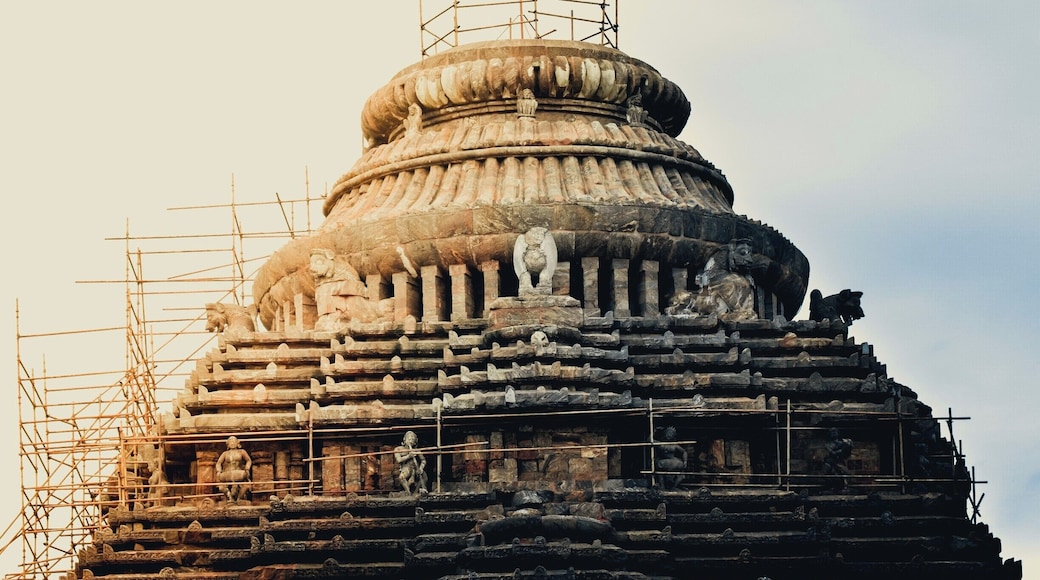
![Konark Sun Temple is a 13th-century CE Sun Temple at Konark in Orissa, India. It is believed that the temple was built by king Narasimhadeva I of Eastern Ganga Dynasty[2] in 1255 CE.[3] The temple complex is in the shape of a gigantic chariot, having elaborately carved stone wheels, pillars and walls. A major part of the structure is now in ruins. The temple is a UNESCO World Heritage Site[4] and has also featured on various list of Seven Wonders of India. The temple is 35 km from Puri and 65 km from Bhubaneswar.
The name Konark derives from the combination of the Sanskrit words, Kona (corner or angle) and Ark (the sun), in reference to the temple which was dedicated to the Sun God Surya.[4]
The monument was also called the Black Pagoda'(Kaala Pagoda) by the European sailors. In contrast, the Jagannath Temple in Puri was called the White Pagoda. Both temples served as important landmarks for the sailors.[5] Konark Sun Temple used Iron beams for its structure.
The temple was originally built at the mouth of the river Chandrabhaga, but the waterline has receded since then. The temple has been built in the form of a giant ornamented chariot of the Sun god, Surya. It has twelve pairs of elaborately carved stone wheels which are 3 meters[4] wide and is pulled by a set of seven horses (4 on the right and 3 on the left).[6] The temple follows the traditional style of Kalinga architecture. It is carefully oriented towards the east so that the first rays of sunrise strikes the principal entrance.[4] The temple is built from Khondalite rocks.[7][8]
The original temple had a main sanctum sanctorum (vimana), which was supposedly 229 feet[6] (70 m) tall. Due to the weight of the superstructure (70 m tall) and weak soil of the area, the main vimana fell in 1837.[9] The audience hall (Jagamohana), which is about 128 feet (39 m) tall, still stands and is the principal structure in the surviving ruins. Among the structures, which have survived to the current day, are the dance hall (Nata mandira) and dining hall (Bhoga mandapa).[4][6]
The Konark temple is also known for its erotic sculptures of maithunas.[10]
Two smaller ruined temples have been discovered nearby. One of them is called the Mayadevi Temple and is located southwest from the entrance of the main temple. It is presumed to have been dedicated to Mayadevi, one of the Sun god's wives. It has been dated to the late 11th century, earlier than the main temple.[11] The other one belongs to some unknown Vaishnava deity. Sculptures of Balarama, Varaha and Trivikrama have been found at the site, indicating it to be a Vaishnavite temple. Both temples have their primary idols missing.
A collection of fallen sculptures can be viewed at the Konark Archaeological Museum which is maintained by the Archaeological Survey of India.](https://images.trvl-media.com/place/6156018/09fea146-89a8-4536-94db-75e3922ba387.jpg?impolicy=fcrop&w=1040&h=580&q=mediumHigh)

![Konark Sun Temple is a 13th-century CE Sun Temple at Konark in Orissa, India. It is believed that the temple was built by king Narasimhadeva I of Eastern Ganga Dynasty[2] in 1255 CE.[3] The temple complex is in the shape of a gigantic chariot, having elaborately carved stone wheels, pillars and walls. A major part of the structure is now in ruins. The temple is a UNESCO World Heritage Site[4] and has also featured on various list of Seven Wonders of India. The temple is 35 km from Puri and 65 km from Bhubaneswar.
The name Konark derives from the combination of the Sanskrit words, Kona (corner or angle) and Ark (the sun), in reference to the temple which was dedicated to the Sun God Surya.[4]
The monument was also called the Black Pagoda'(Kaala Pagoda) by the European sailors. In contrast, the Jagannath Temple in Puri was called the White Pagoda. Both temples served as important landmarks for the sailors.[5] Konark Sun Temple used Iron beams for its structure.
The temple was originally built at the mouth of the river Chandrabhaga, but the waterline has receded since then. The temple has been built in the form of a giant ornamented chariot of the Sun god, Surya. It has twelve pairs of elaborately carved stone wheels which are 3 meters[4] wide and is pulled by a set of seven horses (4 on the right and 3 on the left).[6] The temple follows the traditional style of Kalinga architecture. It is carefully oriented towards the east so that the first rays of sunrise strikes the principal entrance.[4] The temple is built from Khondalite rocks.[7][8]
The original temple had a main sanctum sanctorum (vimana), which was supposedly 229 feet[6] (70 m) tall. Due to the weight of the superstructure (70 m tall) and weak soil of the area, the main vimana fell in 1837.[9] The audience hall (Jagamohana), which is about 128 feet (39 m) tall, still stands and is the principal structure in the surviving ruins. Among the structures, which have survived to the current day, are the dance hall (Nata mandira) and dining hall (Bhoga mandapa).[4][6]
The Konark temple is also known for its erotic sculptures of maithunas.[10]
Two smaller ruined temples have been discovered nearby. One of them is called the Mayadevi Temple and is located southwest from the entrance of the main temple. It is presumed to have been dedicated to Mayadevi, one of the Sun god's wives. It has been dated to the late 11th century, earlier than the main temple.[11] The other one belongs to some unknown Vaishnava deity. Sculptures of Balarama, Varaha and Trivikrama have been found at the site, indicating it to be a Vaishnavite temple. Both temples have their primary idols missing.
A collection of fallen sculptures can be viewed at the Konark Archaeological Museum which is maintained by the Archaeological Survey of India.](https://images.trvl-media.com/place/6156018/aaca044a-35b4-4696-b5fc-4a792070a359.jpg?impolicy=fcrop&w=1040&h=580&q=mediumHigh)

Découvrez cette destination : Temple du Soleil de Konùrak
Les endroits populaires Ă visiter
Plage de KonĂąrak
Envie d'un séjour 100 % détente ? Konark abrite juste ce qu'il vous faut : Plage de Konùrak !Explorez la région et offrez-vous une balade le long de son bord de mer ou faites le plein de culture grùce à ses festivals.
Vishnu Temple
AprĂšs avoir visitĂ© Vishnu Temple, pensez Ă jeter un Ćil aux autres curiositĂ©s et activitĂ©s Ă Puri. Profitez de votre sĂ©jour dans la rĂ©gion pour vous offrir une balade revigorante le long de ses plages.
Sudarshan Crafts Museum
Vous pourrez consacrer une aprÚs-midi à observer les objets exposés à Sudarshan Crafts Museum durant votre séjour à Puri. Explorez la région et laissez-vous surprendre par la beauté de ses levers du soleil ou prenez le temps de découvrir ses temples.
Narendra Sagar
Lors de votre sĂ©jour Ă Puri, ne manquez pas de vous dĂ©tendre lors dâactivitĂ©s en plein air au cĆur des superbes espaces verts que cache Narendra Sagar. Profitez de votre sĂ©jour dans la rĂ©gion pour vous offrir une balade revigorante le long de ses plages.
Vimala Temple
AprĂšs avoir visitĂ© Vimala Temple, pensez Ă jeter un Ćil aux autres curiositĂ©s et activitĂ©s Ă Puri. Profitez de votre sĂ©jour dans la rĂ©gion pour vous offrir une balade revigorante le long de ses plages.
Temple de Jagannath
AprĂšs avoir visitĂ© Temple de Jagannath, pensez Ă jeter un Ćil aux autres curiositĂ©s et activitĂ©s Ă Puri. Profitez de votre sĂ©jour dans la rĂ©gion pour vous offrir une balade revigorante le long de ses plages.
Meilleures offres d'hĂŽtels
Temple du Soleil de Konùrak : vérifiez la disponibilité des hÎtels à proximité

Toshali Sands Puri

MAYFAIR Heritage, Puri

A One Pride - Puri near Sea Beach

Hotel Holiday Resort

HOTEL SAFAL EXOTICA

Pipul Ocean View Resort

Hotel Subham Beach Inn - near Sea Beach

Chanakya BNR hotel

2BHK Homestay @ Gundicha Temple Best 4 Ratha Yatra
Explorez un monde de voyages avec Expedia
- Puri : hÎtels 3 étoiles
- Bhubaneshwar : Maison dâhĂŽtes
- Bhubaneshwar : hĂŽtels HĂŽtels acceptant les animaux de compagnie
- Bhubaneshwar : hĂŽtels HĂŽtels de luxe
- Bhubaneshwar : hĂŽtels HĂŽtels avec vue sur lâocĂ©an
- Bhubaneshwar : hÎtels Séjours réservés aux adultes
- Bhubaneshwar : hĂŽtels
- Odisha : hĂŽtels
- Biju Patnaik : hÎtels à proximité
- Jayadev Vihar : hÎtels HÎtels avec piscine
- Konark : hĂŽtels HĂŽtels dâaventure
- Plage de Purß : hÎtels à proximité
- Puri : AppartâhĂŽtels
- Puri : Maison dâhĂŽtes
- Puri : hĂŽtels HĂŽtels dâaffaires
- Puri : hĂŽtels HĂŽtels de luxe
- Puri : hĂŽtels HĂŽtels avec restaurant
- Puri : hĂŽtels HĂŽtels avec spa
- Puri : hĂŽtels HĂŽtels dâaventure
- Puri : hĂŽtels
- Puri : Lodges
- Puri : Maisons de ville
- Temple de Jagannath : hÎtels à proximité