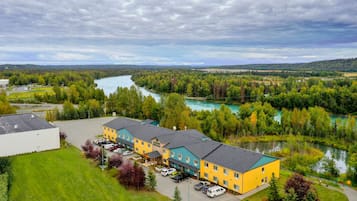
Photo de Sharrie Shaw
Réservez un hÎtel avec une piscine à Nikiski
HÎtels avec une piscine intérieure, extérieure ou chauffée à partir de 99 ⏠!
- Changez dâavisRĂ©servez des hĂŽtels avec annulation gratuite.
- Faites-vous plaisirConnectez-vous pour Ă©conomiser 10 % ou plus sur des milliers dâhĂŽtels.
- Trouvez votre bonheurFaites votre choix parmi prĂšs dâun million dâhĂ©bergements dans le monde entier.
Nikiski : vérifiez la disponibilité des HÎtels avec piscine
Ce soir
Demain
Ce week-end
Le week-end prochain
Nikiski : notre meilleure sĂ©lection dâhĂŽtels avec une piscine
Le nouveau prix est de 99 âŹ
taxes et frais compris
18 déc. - 19 déc.
Prix par nuit le plus bas trouvĂ© au cours des 24 derniĂšres heures sur la base dâun sĂ©jour dâune nuit pour 2 adultes. Les prix et la disponibilitĂ© sont susceptibles de changer. Des conditions supplĂ©mentaires peuvent sâappliquer.
![The Arctic Circle is one of the five major circles of latitude that mark maps of the Earth. As of 16 February 2015, it runs 66°33âČ45.6âł north of the Equator.
The region north of this circle is known as the Arctic, and the zone just to the south is called the Northern Temperate Zone. The equivalent polar circle in the Southern Hemisphere is called the Antarctic Circle.
The Arctic Circle is the southernmost latitude in the Northern Hemisphere at which the sun can remain continuously above or below the horizon for 24 hours (at the June solstice and December solstice respectively). North of the Arctic Circle, the sun is above the horizon for 24 continuous hours at least once per year (and therefore visible at midnight) and below the horizon for 24 continuous hours at least once per year (and therefore not visible at noon). On the Arctic Circle those events occur, in principle, exactly once per year, at the June and December solstices, respectively. However, in practice, because of atmospheric refraction and mirages, and because the sun appears as a disk and not a point, part of the midnight sun may be seen on the night of the northern summer solstice up to about 50âČ (90 km (56 mi)) south of the Arctic Circle; similarly, on the day of the northern winter solstice, part of the sun may be seen up to about 50âČ north of the Arctic Circle. That is true at sea level; those limits increase with elevation above sea level, although in mountainous regions there is often no direct view of the true horizon.
The position of the Arctic Circle is not fixed. It directly depends on the Earth's axial tilt, which fluctuates within a margin of 2° over a 40,000-year period,[2] notably due to tidal forces resulting from the orbit of the Moon. The Arctic Circle is currently drifting northwards at a speed of about 15 m (49 ft) per year; see Circle of latitude for more information.
#snow](https://images.trvl-media.com/place/6140564/a9f9449e-bab4-40a6-a9a1-5356b0cc2aa8.jpg?impolicy=fcrop&w=1200&h=500&q=medium)